
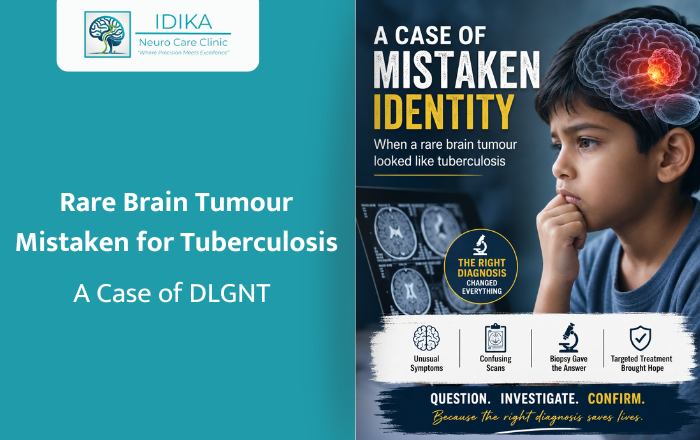
When a rare brain tumour looked like tuberculosis
Every doctor has a few patients they remember long after they have left the hospital.
Not necessarily because the surgery was difficult. Sometimes, it is because the journey to the correct diagnosis is itself a story.
This was one such child.
It started with a seizure
Six months before the family came to us, their eight-year-old son had his first seizure.
It was frightening and sudden.
- He had vomiting
- Followed by stiffening of one side of his body
- And then a generalized seizure
His brain scan showed abnormalities, and in a country like India, where tuberculosis is common, the findings appeared to fit the picture of tuberculosis involving the brain.
Treatment for tuberculosis was started.
The family hoped that this would be the beginning of his recovery.
But it wasn’t.
Something didn't add up
Over the following months:
- The seizures continued.
- Instead of improving, his brain scans showed that the disease was progressing.
- The lining covering the brain was becoming thicker.
- More cyst-like lesions were appearing.
- His behaviour also began to change.
A child who had once been cheerful and himself became increasingly irritable and aggressive.
The treatment for tuberculosis was not working.
A brain biopsy was suggested on more than one occasion, but understandably, the family was reluctant.
The thought of putting an eight-year-old child through a brain operation is frightening for any parent.
They hoped that with more time and treatment, things would improve.
They didn’t.
Six months later, they came to us
When the family finally approached us, I went back to the beginning and looked at all his scans not just the latest one.
That was important.
Sometimes, a single scan can be confusing. But when you watch a disease unfold over time, it begins to tell its own story.
To me, the pattern was concerning for something quite different from tuberculosis.
The concerning clues
- The way the disease was spreading over the surface of the brain
- The development of multiple cystic lesions
- Most importantly, the continued progression despite appropriate treatment for tuberculosis
These did not fit the expected course of an infection.
I explained to the family that I strongly suspected a rare childhood brain tumour called Diffuse Leptomeningeal Glioneuronal Tumour, or DLGNT.
It is an extremely uncommon tumour.
Most people have never heard of it.
But the pattern on his scans was remarkably suggestive.
There was only one problem.
We needed to prove it.
Sometimes, the most important brain surgery is a biopsy
When people hear the words brain surgery, they often imagine a surgeon removing a tumour.
That is not always the purpose of an operation.
Sometimes, the most important thing we can do is take a very small piece of tissue and ask the pathologist a simple question:
What exactly are we dealing with?
After detailed discussions with the family, they agreed to proceed with a biopsy.
A small operation was performed and tissue was obtained from the abnormal area.
Then came the wait.
The microscope gave us the answer
The biopsy confirmed what I had suspected.
It was not tuberculosis.
It was Diffuse Leptomeningeal Glioneuronal Tumour.
A rare tumour of childhood that can spread extensively over the surface of the brain and can closely resemble infections such as tuberculosis on scans.
The diagnosis finally had a name.
But for the family, accepting that name was another journey altogether.
When the diagnosis is difficult to accept
Being told that your child has a rare brain tumour is devastating.
Even after the biopsy had confirmed the diagnosis, the family struggled to accept it.
They searched for another possibility and eventually turned to Ayurvedic treatment, hoping that perhaps there was another way to make their child better.
They tried.
But the disease did not respond.
The seizures and other problems continued.
Eventually, they returned to us.
This time, they were ready to fight the disease they now knew they were dealing with.
Finally, we knew what we were fighting
Further testing showed that the tumour carried a particular genetic change called BRAF V600E.
That finding was important because it meant that the tumour could potentially be treated with medicines specifically designed to target this abnormal pathway.
Treatment
Dabrafenib and Trametinib was started.
And then something remarkable happened.
Within a short period, the family began noticing a difference.
- His behaviour improved.
- The irritability began to settle.
- The child they remembered started coming back.
- His seizures also improved.
After months of uncertainty, they finally had something they had been waiting for all along:
a treatment that was working.
The lesson was bigger than the tumour
This case was not simply about a rare brain tumour.
It was a reminder of one of the most important principles in medicine:
When a diagnosis does not behave the way it should, we have to be willing to question the diagnosis.
Tuberculosis is common.
DLGNT is extraordinarily rare.
And that is precisely what makes cases like this difficult.
Doctors naturally think of common diseases first. But sometimes, a rare disease can wear the disguise of a familiar one.
In this child, the clues were there.
- The disease kept progressing.
- The scans kept changing.
- The treatment wasn’t working.
- The pattern didn’t fit.
The biopsy did not suddenly create the diagnosis.
It gave us the confirmation we needed to prove what the clinical picture had already been telling us.
Most importantly, it allowed us to stop treating the wrong enemy and start treating the right one.
Because sometimes, the most important step in treating a disease is simply getting the courage to ask:
What if this isn’t what we think it is?
Consult a Pediatric Brain & Spine Specialist
MBBS, DNB – Neurosurgery (Gold Medalist), MNAMS, FRCS (Neurosurgery)
Fellowships in Pediatric Neurosurgery & Neuro-oncology
Pediatric Brain & Spine Specialist
MRR Children’s Hospital, Thane