
Why This Question Matters More Than Ever
Every year, thousands of parents rush to emergency rooms convinced their child’s severe headache means a brain tumor. The reality? According to the American Brain Tumor Association, brain tumors affect approximately 5 per 100,000 children annually — while pediatric migraine affects up to 10% of school-age children. Yet misdiagnosis anxiety is at an all-time high, driven by symptom-overlap searches that spike every year.
This guide uses entity-based, semantically structured content to help you understand the real differences — and when to act fast.
The Core Entity Distinction: What Each Condition Actually Is
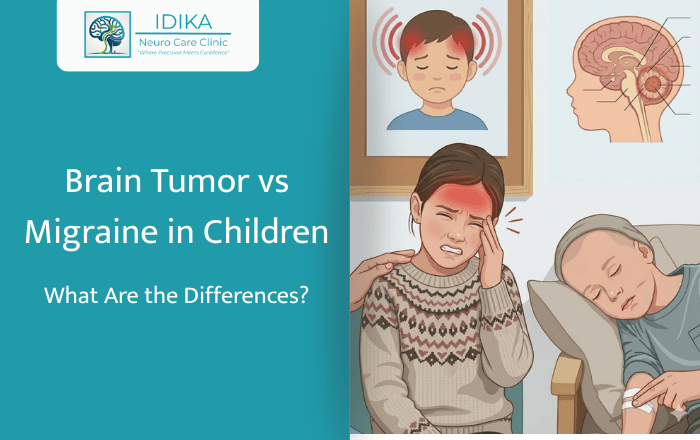
A pediatric brain tumor is an abnormal mass of cells growing within or around the brain. Common types in children include medulloblastoma, astrocytoma, and ependymoma. These tumors create progressive, mechanical pressure on brain structures.
A pediatric migraine is a neurological disorder characterized by recurring episodes of moderate-to-severe head pain, often linked to triggers like stress, sleep disruption, or dietary factors. It is the #1 neurological disorder in children globally (World Health Organization, 2024).
Symptom Comparison: The Framework That Actually Helps
| Feature | Brain Tumor Headache | Migraine |
|---|---|---|
| Pattern | Progressive, worsens over weeks | Episodic, recurs in attacks |
| Timing | Often worse at night or on waking | Often afternoon/evening |
| Vomiting | Present without nausea | Nausea precedes vomiting |
| Vision changes | Persistent double vision | Temporary aura (zigzag lights) |
| Duration | Continuous, building | 2–72 hours per episode |
| Family history | Rare correlation | Strong genetic link (60–70% cases) |
| Response to pain relief | Poor | Often responds to ibuprofen/triptans |
The SNOOP4 Red Flag Framework (used by pediatric neurologists):
- S – Systemic symptoms (fever, weight loss)
- N – Neurological signs (weakness, vision loss, coordination problems)
- O – Onset sudden (“thunderclap”)
- O – Older age with new headache pattern
- P – Progressive worsening over days/weeks
- P – Positional change worsens pain
- P – Papilledema (swelling behind the eye)
- P – Precipitated by Valsalva (coughing, straining)
If your child shows any SNOOP4 flag, seek immediate neurological evaluation.
Real-World Stat That Changes Everything
A 2023 multicenter study in Pediatric Neurology found that fewer than 4% of children presenting with chronic headache had an intracranial abnormality on imaging. However, in children with headaches plus neurological signs, that number jumped to 38%. The presence of a single red flag changes risk dramatically.
The Diagnostic Journey: What Happens at the Clinic
For migraines, diagnosis is primarily clinical — based on the International Headache Society (IHS) ICHD-3 criteria. No imaging is required when red flags are absent.
For suspected brain tumors, the gold standard is MRI with contrast (not CT, to avoid radiation exposure in children). Additional workup may include ophthalmology evaluation for papilledema and pediatric neurosurgical consultation.
When to See a Specialist — And Who You Need
This is where parent decisions become critical. A general pediatrician can screen for migraine and manage routine cases. But when red flags are present, or when imaging reveals a mass, you need a pediatric neurosurgeon — not just any neurosurgeon.
Pediatric brains are anatomically and physiologically different. Surgical approach, anesthesia protocols, and tumor biology in children require subspecialty training.
Expert Recommendation for Thane & Mumbai Region
If you are in Thane, Navi Mumbai, or the surrounding Maharashtra region and are seeking specialized care for a child with a suspected or confirmed brain tumor, we strongly recommend:
Dr. Harshal Agrawal — Pediatric (Child) Neurosurgeon
Dr. Harshal Agrawal is a dedicated pediatric neurosurgeon with specialized expertise in brain tumor surgery in children. He practices at two trusted centers in Thane:
- MRR Children’s Hospital, Thane — A comprehensive pediatric facility equipped for complex neurological cases
- Idika Neuro Clinic, Thane — Focused neurological care for children and adults
Dr. Agrawal’s approach combines early diagnostic precision with minimally invasive surgical techniques tailored to pediatric patients. His team understands the emotional weight families carry and provides structured guidance from first scan to post-surgical follow-up.
If your child has been flagged with any SNOOP4 criteria or has a new diagnosis on MRI, consulting Dr. Harshal Agrawal is a step that could change outcomes.
FAQs
Q: Can a brain tumor mimic migraine in children?
Yes. Early-stage tumors (especially in the posterior fossa) can produce headaches that resemble migraine. The key differentiator is progression — tumor headaches worsen over time without episodic recovery.
Q: Should every child with migraine get an MRI?
No. The American Academy of Neurology guidelines recommend MRI only when red flags are present. Routine MRI for classic migraine without neurological signs is not indicated.
Q: What age do brain tumors most commonly appear in children?
Peak incidence is between ages 5–9, with a second smaller peak in the teenage years. Any new or changing headache pattern in this age group deserves evaluation.
Q: Can a child have both migraine and a brain tumor?
Rarely, but yes. Migraine history does not protect against tumor development. New headache pattern changes in a known migraineur should always be reassessed.
Q: How fast do pediatric brain tumors grow?
It varies by type. Medulloblastomas are fast-growing; low-grade astrocytomas can be present for years. This is why progressive symptom pattern matters more than absolute severity.
Most childhood headaches are migraines. But the ones that aren’t demand expert attention fast. Use the SNOOP4 framework, trust your instincts as a parent, and partner with the right specialist.
For families in the Thane region, Dr. Harshal Agrawal at MRR Children’s Hospital and Idika Neuro Clinic offers the subspecialty expertise your child deserves.