
When a brain scan shows an arachnoid cyst in a child, one of the first questions parents may have is, “Does my child need surgery?” The answer is not always yes.
Many arachnoid cysts do not cause symptoms and may only be discovered during an imaging test performed for another reason. Whether treatment is necessary depends on factors such as the cyst’s size and location, whether it is putting pressure on nearby brain structures, whether it is causing symptoms, and whether it is changing over time.
Understanding what an arachnoid cyst is and when treatment may be considered can help parents make informed decisions with a pediatric neurosurgeon.
What Is an Arachnoid Cyst?
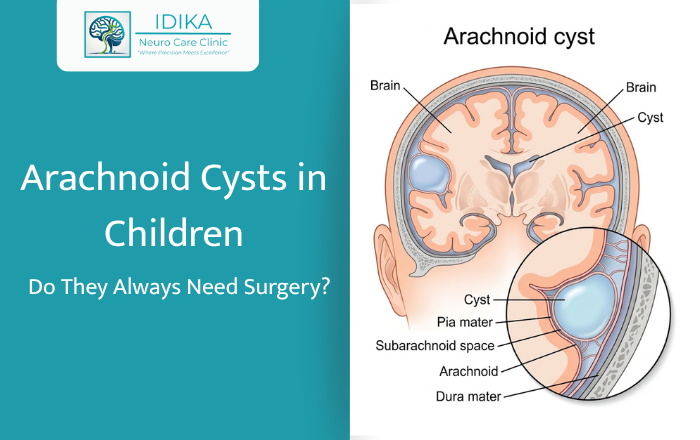
An arachnoid cyst is a fluid-filled sac that develops in or around the brain or spinal cord. It is associated with the arachnoid membrane, one of the protective layers surrounding the brain and spinal cord.
Arachnoid cysts can be present from birth or develop later. In children, they are often found incidentally during brain imaging.
Importantly, finding an arachnoid cyst does not automatically mean that it is dangerous or that surgery is required.
Do Arachnoid Cysts in Children Always Need Surgery?
No, arachnoid cysts in children do not always require surgery.
If a cyst is small, stable and not causing symptoms or significant pressure on the surrounding brain, a doctor may recommend observation rather than immediate treatment.
This may involve clinical follow-up and, when appropriate, repeat imaging to monitor the cyst.
Surgery may be considered when the cyst is causing significant problems, growing, or producing pressure on surrounding structures. The decision is made after considering the child’s symptoms, examination findings and imaging results.
What Symptoms Can an Arachnoid Cyst Cause?
Many children with arachnoid cysts have no symptoms. When symptoms do occur, they can vary depending on the cyst’s location and size.
Possible symptoms may include:
- Headaches
- Nausea or vomiting
- Seizures
- Problems with balance or coordination
- Changes in vision
- Developmental or neurological concerns in some cases
- Symptoms related to increased pressure inside the skull
These symptoms are not specific to arachnoid cysts. Headaches, vomiting or seizures, for example, can have many different causes. A child with these symptoms needs appropriate medical assessment rather than assuming that an arachnoid cyst is responsible.
How Are Arachnoid Cysts Diagnosed?
Brain imaging is important for identifying and assessing an arachnoid cyst.
Magnetic resonance imaging, commonly called an MRI, can provide detailed images of the brain and help doctors understand the cyst’s location, size and relationship with nearby structures. Other imaging tests may also be used depending on the clinical situation.
The scan is interpreted alongside the child’s symptoms and medical examination. The appearance of a cyst on imaging alone does not determine whether surgery is necessary.
When Is Observation Appropriate?
Observation may be considered when an arachnoid cyst is not causing significant symptoms or pressure-related complications.
Depending on the individual situation, follow-up may involve monitoring the child’s symptoms and reviewing imaging over time.
Parents should understand that observation does not mean ignoring the cyst. It means that the medical team has determined that immediate intervention may not be necessary and that monitoring is appropriate.
The follow-up plan can vary from child to child.
When Might Surgery Be Considered?
Surgery may be considered when an arachnoid cyst is associated with significant symptoms or complications.
Factors that may influence the decision include:
- Evidence that the cyst is causing pressure on the brain
- Symptoms that are considered related to the cyst
- Enlargement or significant change in the cyst
- Problems caused by blockage of normal cerebrospinal fluid flow
- Neurological findings associated with the cyst
The choice of procedure depends on the cyst’s location, size, anatomy and the child’s overall clinical situation.
Possible surgical approaches include procedures that create an opening to allow the cyst fluid to drain into the normal fluid spaces around the brain, or other approaches selected according to the individual case.
Surgery is not automatically the next step simply because an arachnoid cyst has been identified.
What Should Parents Consider Before Choosing Surgery?
If surgery has been recommended, parents may understandably have several questions.
It can be helpful to discuss:
- Why treatment is being recommended
- Whether the cyst is causing the child’s symptoms
- What the imaging shows
- Whether observation is a reasonable alternative
- Which procedure is being considered and why
- Possible benefits and risks of the procedure
- What follow-up may be required
A pediatric neurosurgeon can assess the child’s individual situation and explain the available options based on clinical findings and imaging.
When Should You Consult a Doctor?
Parents should seek medical evaluation if a child develops concerning neurological symptoms such as persistent or worsening headaches, repeated vomiting, seizures, significant changes in vision, problems with balance, unusual changes in behaviour or consciousness, or other symptoms that are concerning.
Urgent medical attention may be necessary when symptoms are sudden, severe or associated with a significant change in the child’s neurological condition.
If an arachnoid cyst has already been identified, follow-up with an appropriate specialist can help determine whether monitoring or treatment is appropriate.
Frequently Asked Questions
1. Is an arachnoid cyst in a child dangerous?
Not necessarily. Some arachnoid cysts cause no symptoms and may remain stable. The potential significance depends on factors such as the cyst’s location, size and effect on nearby structures.
2. Can an arachnoid cyst disappear on its own?
Arachnoid cysts generally do not simply disappear, but some remain stable and do not require treatment. Follow-up depends on the individual child’s situation.
3. Does every child with an arachnoid cyst need an MRI?
MRI is commonly used to assess brain cysts in detail, but the appropriate imaging approach depends on the child’s clinical situation and the doctor’s assessment.
Have questions? We’re just a message away! Contact us on WhatsApp — Click Here to Chat with Us
Consult a Pediatric Neurosurgeon
If your child has been diagnosed with an arachnoid cyst, the next step is not necessarily surgery. A careful assessment can help determine whether the cyst is simply an incidental finding or whether it may be contributing to the child’s symptoms.
Dr. Harshal Agrawal, Pediatric Neurosurgeon, is associated with MRR Children’s Hospital & Idika Neuro Clinic in Mumbai & Thane. Parents can discuss their child’s imaging findings, symptoms and treatment options with a pediatric neurosurgeon to understand whether observation or further treatment may be appropriate.
Conclusion
An arachnoid cyst found on a child’s brain scan can understandably cause concern, but its presence does not automatically mean that surgery is needed. Some cysts can be monitored when they are not causing symptoms or significant pressure.
When symptoms or complications are present, treatment may need to be considered. The decision should be based on the child’s clinical condition, imaging findings and assessment by a pediatric neurosurgeon.
For parents, the most useful question is not simply “Does my child have an arachnoid cyst?” but rather, “Is this cyst affecting my child, and does it require treatment?” A specialist evaluation can help answer that question.