
Hearing the words “your child needs brain surgery” can shake any parent to the core. Your mind races, your heart sinks, and suddenly you’re searching for answers at 2 AM. If you’re in that moment right now — take a breath. You are not alone, and there is good news.
Endoscopic brain surgery in children has changed the way doctors treat serious brain conditions in kids. It’s safer, gentler, and gets children back to their normal lives much faster than traditional surgery. This guide will walk you through everything you need to know — in simple, honest language.
What Is Endoscopic Brain Surgery?
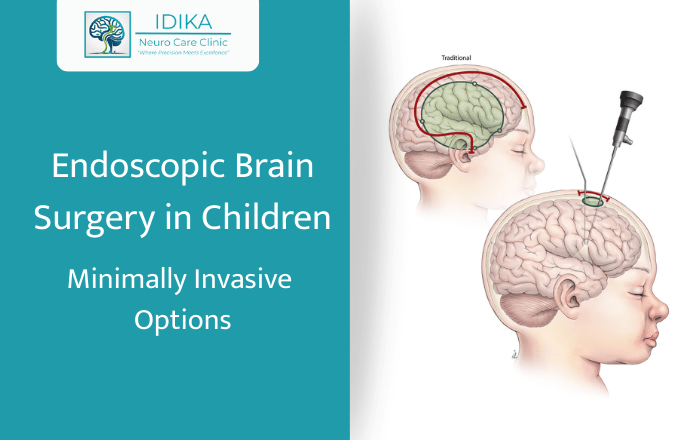
Endoscopic brain surgery uses a thin tube with a tiny camera — called an endoscope — inserted through a very small opening in the skull. The surgeon watches a live screen and performs the procedure through that same small opening.
No large cuts. No removing big sections of the skull. Just a small, controlled approach that protects the healthy brain tissue around it.
Which Conditions in Children Can Be Treated This Way?
Endoscopic brain surgery for children is used to treat several conditions, including:
- Hydrocephalus — a build-up of fluid in the brain. A procedure called Endoscopic Third
- Ventriculostomy (ETV) creates a small opening so fluid drains naturally, often removing the need for a permanent shunt.
- Brain tumors in children — some tumors near fluid-filled spaces can be safely removed or biopsied.
- Arachnoid cysts — fluid sacs on the brain’s surface that can be opened and drained.
- Craniosynostosis — where skull bones fuse too early in babies. When treated before 6 months, this approach results in much less blood loss than open surgery.
- Colloid cysts — small but dangerous cysts inside the brain’s ventricles.
Why Is This Approach Better for Kids?
Children’s brains are still growing. Any surgery that reduces damage to surrounding tissue matters enormously for their long-term development.
According to the World Health Organization, brain tumors make up about 26% of all childhood cancers. Meanwhile, hydrocephalus affects 1 in every 500 children. These numbers show just how many families are quietly facing these challenges every single day.
Here’s what pediatric endoscopic brain surgery offers compared to open surgery:
| Open Surgery | Endoscopic Surgery | |
|---|---|---|
| Hospital Stay | 7–14 days | 2–5 days |
| Recovery Time | Weeks to months | Days to weeks |
| Scarring | Significant | Barely visible |
| Blood Loss | More | Much less |
| Infection Risk | Higher | Lower |
For a child — especially a young one — these differences are enormous.
Is It Safe? What Do the Numbers Say?
Yes — and the research backs this up strongly.
- ETV (the most common endoscopic procedure for hydrocephalus in children) has a success rate of 65–90% depending on the child’s age and condition.
- Hospital stays are 50–70% shorter on average.
- Complication rates are significantly lower compared to open surgery.
No surgery is completely without risk. Bleeding, infection, or rare injury to nearby tissue can still occur. This is exactly why choosing an experienced pediatric brain surgeon is the most important decision you will make for your child.
What Happens During and After Surgery?
- Before surgery: Your child will have MRI and CT scans so the surgeon can plan the procedure with full precision.
- During surgery: Your child will be under general anesthesia. A tiny incision is made, the endoscope is guided to the target area, and the surgeon completes the procedure — all through that one small opening.
- After surgery: Most children wake up alert within hours. Pain is usually mild and managed easily with medication.
- At home: Expect 2–4 weeks of rest. No rough play during this period. Most children return to school within 3–4 weeks — which continues to surprise parents who expected a much longer recovery.
- Long-term: Regular follow-up scans, neurological check-ups, and developmental monitoring are part of the plan.
Take the Next Step — Your Child Cannot Wait
Brain conditions in children do not improve on their own. Early action by the right surgeon protects your child’s brain, development, and future.
Trust Dr. Harshal Agrawal — Pediatric Brain Surgeon in Thane
Dr. Harshal Agrawal brings 8+ years of focused experience in endoscopic brain surgery for children and is one of the most trusted names in pediatric neurosurgery in Thane.
He practices at MRR Children’s Hospital, Thane, where every child is treated with the attention, skill, and warmth they deserve. Parents consistently describe him as calm, clear, and genuinely caring — someone who makes an incredibly hard time feel a little more manageable.
If your child has been diagnosed with hydrocephalus, a brain cyst, a tumor, or any neurological condition — do not delay.
📞 Book your consultation with Dr. Harshal Agrawal at MRR Children’s Hospital, Thane today.
Because every child deserves a surgeon who truly cares.