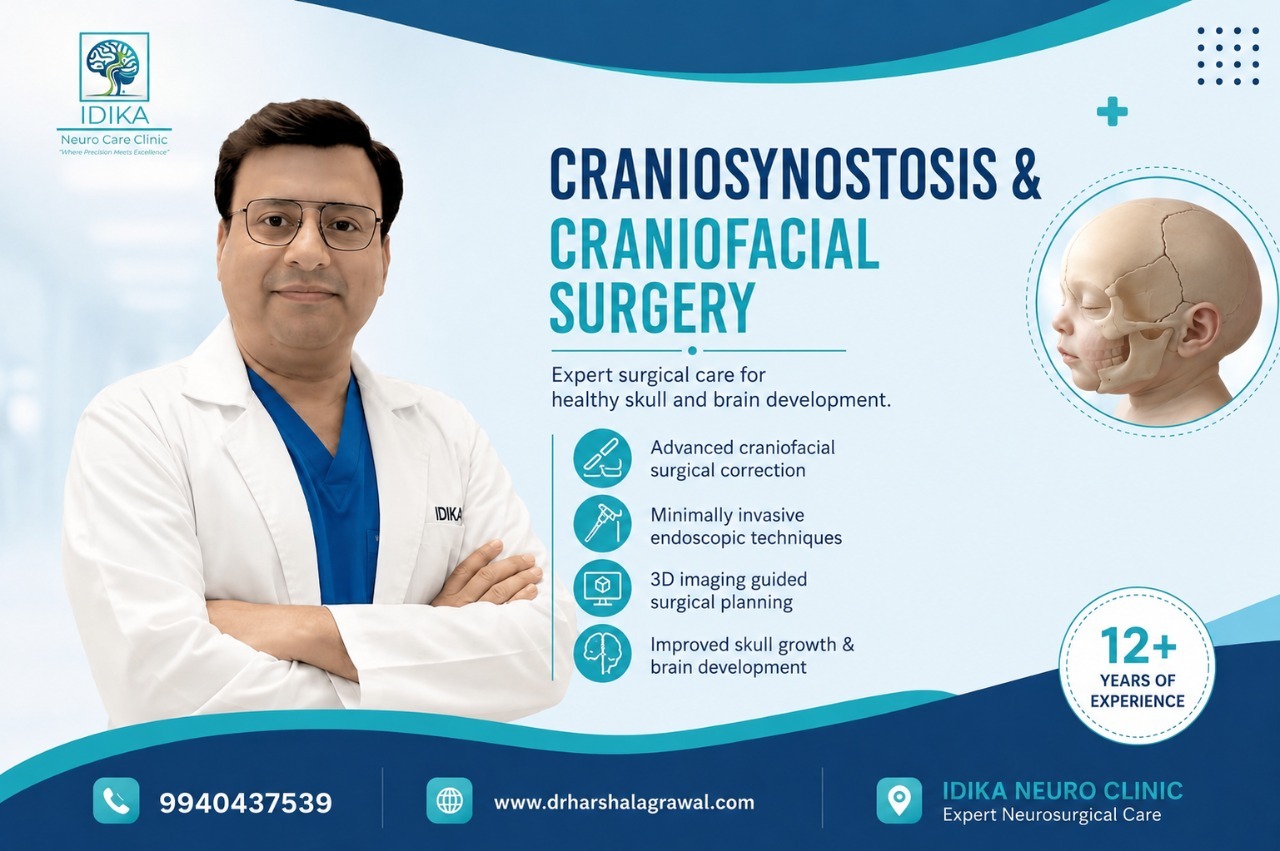
As a parent, noticing something unusual about your baby’s head shape can be frightening. You search for answers, wonder if it’s serious, and feel the urgency of finding the right doctor quickly. If your child has been diagnosed with craniosynostosis or another craniofacial condition, you are not alone and you’ve come to the right place.
Dr. Harshal Agrawal is a trusted pediatric neurosurgeon for craniosynostosis with over 12+ years of specialized experience in treating craniofacial disorders in children. Families across Mumbai, Thane, and the wider Maharashtra region seek his expertise for timely, careful, and effective surgical care.
Craniosynostosis is a congenital condition where one or more of the fibrous joints (sutures) between a baby’s skull bones fuse prematurely — before the brain has fully developed. This early fusion restricts the normal growth of the skull and can put increasing pressure on the developing brain.
Left untreated, craniosynostosis can affect brain development, cause raised intracranial pressure, impair vision, and lead to cognitive or developmental delays. Early diagnosis and surgical correction give children the best possible start in life.
There are several forms of this condition, each affecting a different skull suture and producing a distinct head shape:
Dr. Agrawal manages the full spectrum of these conditions, including complex syndromic cases that require advanced planning and multidisciplinary coordination.
Recognizing the signs early can significantly improve treatment outcomes. Speak with a specialist if your child shows any of the following:
If you notice any of these signs, do not wait. An early evaluation by a pediatric neurosurgeon can make a meaningful difference.
Not all head shape differences require surgery. However, true craniosynostosis where sutures have prematurely fused almost always requires surgical correction to allow the brain adequate room to grow.
Craniosynostosis surgery is recommended when:
The ideal window for most surgical corrections is between 3 and 12 months of age. The skull is still soft and malleable, blood loss is manageable, and brain recovery is at its most resilient. Early intervention is not just advisable, it is often essential.
Craniofacial surgery involves carefully reshaping the skull to create adequate space for the growing brain and to restore a more typical head and facial appearance.
The two primary surgical approaches include:
Both approaches are performed with the highest standards of safety, precision, and surgical care.
For eligible patients, minimally invasive craniosynostosis surgery offers meaningful advantages including shorter operating times, reduced blood loss, smaller scars, and faster recovery. Dr. Agrawal evaluates each child individually to determine which surgical technique provides the safest and most effective outcome.
Advanced pre-surgical planning using 3D CT imaging allows the surgical team to map out the correction in detail before a single incision is made, improving precision and reducing intraoperative decision-making.
Recovery varies depending on the type of surgery and the child’s age:
Families are guided through every stage of recovery with clear instructions and ongoing support from Dr. Agrawal’s team.
Choosing a surgeon for your child is one of the most important decisions you will make. Here is what sets Dr. Agrawal apart:
Dr. Harshal Agrawal is available at multiple leading pediatric neurosurgery hospitals across Mumbai and Thane. Families in Navi Mumbai, Pune, and other parts of Maharashtra regularly travel to access his care.
Click here to confirm the current hospital locations, OPD schedules, and appointment availability.
Craniosynostosis surgery is a procedure to correct the premature fusion of skull bones in infants. It involves reshaping the skull to allow the brain to grow normally and to improve head and facial symmetry. It is performed under general anesthesia by a specialized pediatric neurosurgeon.
Yes. When performed by an experienced pediatric neurosurgeon at a well-equipped facility, craniosynostosis surgery has a high safety profile. Advances in anesthesia, surgical technique, and perioperative care have made these procedures significantly safer over the past two decades.
Most specialists recommend surgery between 3 and 12 months of age. At this stage, the skull bones are still flexible, the brain is growing rapidly, and surgical outcomes tend to be superior. Endoscopic procedures are best performed before 4 months.
Dr. Harshal Agrawal is a highly regarded pediatric neurosurgeon for craniosynostosis in Mumbai and Thane, with over 12 years of focused experience in craniofacial surgery. He is known for his surgical precision, patient-centered care, and strong outcomes in both routine and complex cases.
True craniosynostosis caused by fused sutures cannot be corrected without surgery. Helmet therapy alone is not an effective treatment for craniosynostosis, though it is used after endoscopic surgery to guide skull reshaping.
Early diagnosis and timely treatment can support healthy brain and skull development in children with craniosynostosis and craniofacial disorders.
If you are concerned about your child’s head shape, skull growth, or craniofacial development, consult Dr. Harshal Agrawal for expert evaluation and personalized treatment guidance.
Speak with a pediatric craniofacial specialist today. Your child’s brain health cannot wait.
Dr. Harshal Agrawal is a trusted Pediatric Neurosurgeon in Mumbai & Thane, offering specialized care for brain, spine, and neurological conditions with expert precision and compassion.
Copyright © 2026 Dr. Harshal Agrawal All rights reserved. Powered By DMX DIGITAL
